Data engineering has quietly gone through a massive shift. The teams that still think in terms of “ETL jobs” are constantly firefighting, while the teams that think in terms of real-time data platforms are shipping features, reacting to customers in minutes, and unlocking entirely new revenue streams. The difference is no longer just about technology choices—it’s about how a business sees and uses its data.
ETL Belongs To An Older Era
For a long time, ETL was the backbone of analytics. Data was extracted from a few systems, transformed in large batches, and loaded into a warehouse overnight. That worked when reports were weekly, customers were mostly offline, and “yesterday’s numbers” were good enough. Today, that world just does not exist anymore.
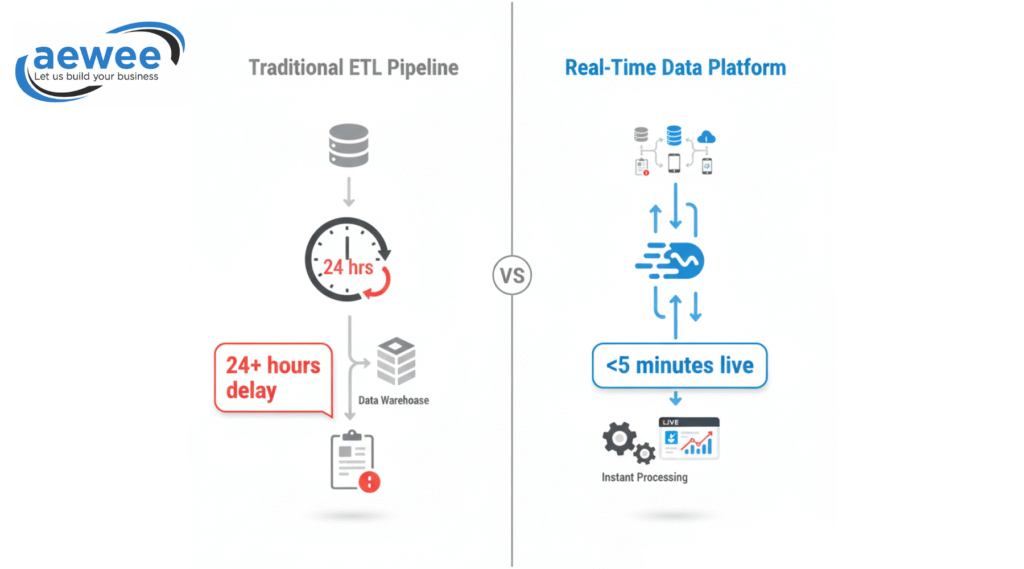
Modern businesses operate in real time. Customers expect instant confirmations, live tracking, and personalized experiences in every interaction. A batch job that runs at 2 AM cannot support real-time fraud detection, dynamic pricing, or live operational dashboards. Traditional ETL pipelines also become fragile as data sources grow—one schema change, one delayed file, and your entire reporting stack collapses for the day.
The result is a familiar pattern: data engineers stuck maintaining scripts instead of building new capabilities, analysts waiting for delayed data, and leadership flying blind during the most critical moments. The bottleneck is not your team’s capability—it is the architecture itself.
From Pipelines To Platforms
The shift that is happening in data engineering is simple but profound: moving from building ETL pipelines to building scalable data platforms. Pipelines move data from Point A to Point B. Platforms create an environment where data is continuously collected, processed, governed, and made available to every team that needs it.
In a modern data platform, data flows as events rather than static tables. When a customer places an order, that event is captured, enriched, and made available to multiple services almost immediately. Marketing can update attribution, operations can adjust inventory, finance can track revenue, and product can feed that signal into recommendation models.
This kind of platform thinking changes the questions teams ask. Instead of “How do we move this table to the warehouse?” the question becomes “How do we design a system where any new event in the business is reliably captured, trusted, and usable in minutes?” That is a very different mindset—and it leads to very different outcomes.
What A Real-Time Data Platform Looks Like
A scalable, real-time data platform typically brings together a few core building blocks:
- Ingestion layer that can handle streaming and batch data from SaaS tools, internal applications, logs, and IoT devices
- Processing layer that can perform real-time transformations, aggregations, and quality checks
- Storage layer that combines data lakes and warehouses for both flexibility and performance
- Serving layer that powers dashboards, APIs, experiments, ML models, and real-time use cases
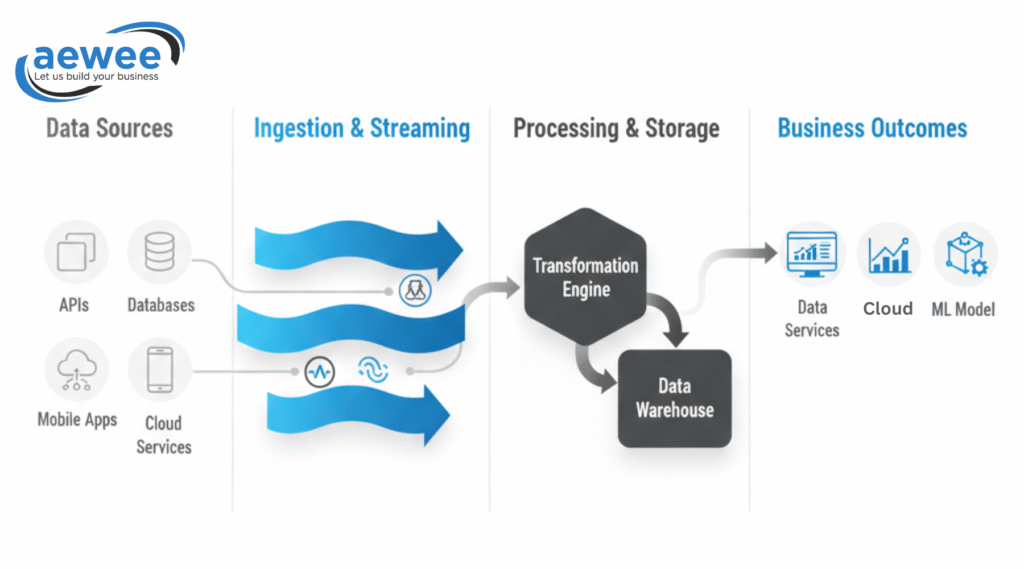
In practical terms, this means events coming from your website, app, CRM, payment gateway, and internal tools are continuously flowing into a central platform. Checks for data quality, schema consistency, and governance are applied automatically. The same data assets can then support simple dashboards for business users and advanced use cases like churn prediction for data science teams.
Notice what is missing from this picture: manually triggered batch jobs that are tightly coupled to a single report or department. When a platform is built right, new use cases become a matter of configuration and modeling—not standing up a brand-new pipeline every time.
Why This Shift Matters For The Business
This evolution is not just a technical upgrade. It directly impacts how a business competes, grows, and serves its customers. Companies with real-time platforms:
- Make decisions based on what is happening now, not what happened last week
- Identify issues in operations before customers notice them
- Personalize experiences in the moment, when it actually influences behavior
- Reduce operational risk by having a single, governed view of data across systems
Consider an e-commerce brand during a major festive sale. With a traditional ETL setup, performance data is delayed. Overspending, stockouts, or campaign misalignment may only become visible after the damage is done. With a real-time data platform, bids can be adjusted dynamically, inventory can be protected, and customer communication can be updated instantly when products sell out.
The same pattern shows up in fintech for fraud detection, logistics for route optimization, healthcare for patient monitoring, and SaaS products for in-app personalization. In each case, real-time data is the difference between reacting late and acting at the right moment.
From “More Pipelines” To “Stronger Platforms”
A common trap for growing teams is to respond to complexity by adding more ETL jobs. Every new tool, integration, or report becomes another one-off pipeline. Over time, this creates a fragile web of scripts that only a few engineers fully understand.
A platform approach solves this by introducing standard patterns and reusable components. New data sources plug into shared ingestion services. Transformations are designed as modular, tested units. Lineage is tracked so it is clear where every metric comes from. Security and governance are applied centrally rather than scattered across dozens of jobs.
For leadership, this means:
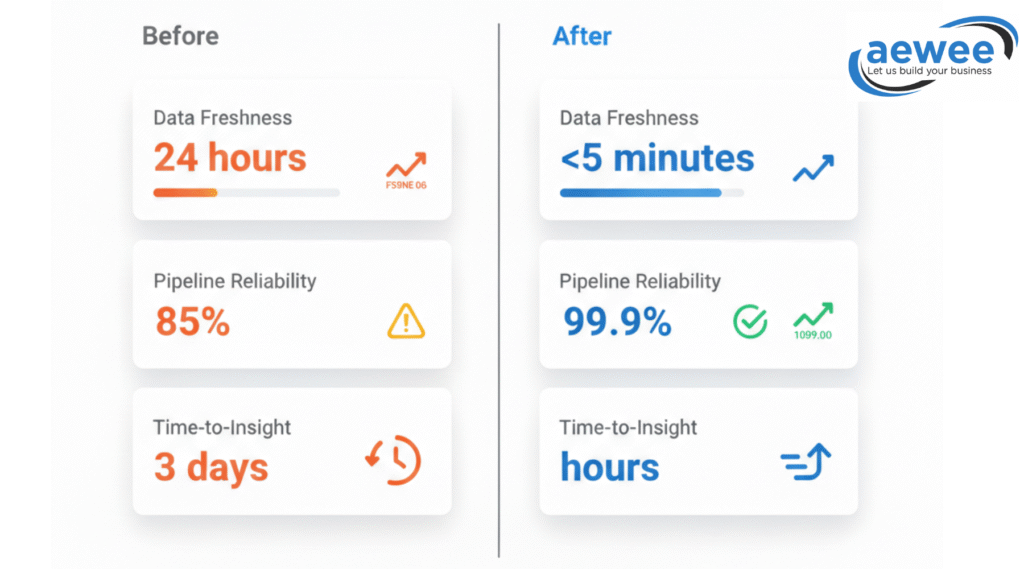
- More predictable data reliability
- Shorter lead time from idea to insight
- Lower long-term maintenance cost
- A foundation that can support AI and advanced analytics without re-architecting everything later
For data teams, it means spending less time chasing broken jobs and more time creating new value.
How AEWEE Thinks About Modern Data Platforms
At AEWEE, the starting point is never “Which tool should we use?” The starting point is “What decisions should your business be able to make in real time?” and “Who inside your company needs trustworthy data, and how fast?”. From there, the platform is designed backwards from business outcomes.
Typical focus areas include:
- Real-time customer and revenue visibility for leadership
- Marketing and product feedback loops that update within minutes
- Operational dashboards for inventory, logistics, or internal processes
- Data foundations for AI/ML, so future initiatives do not require another full rebuild
The implementation might leverage cloud-native services, streaming technologies, and modern warehouses, but the core promise is simple: a scalable, reliable data platform that your teams can actually trust and use.
When Is The Right Time To Modernize?
The best signal that it is time to move beyond ETL is not a specific technology milestone—it is the pain your teams feel day to day. Some warning signs:
- Your reports frequently break when a source system changes a column
- Analysts keep their own shadow spreadsheets because they do not trust central dashboards
- Critical decisions are delayed because the “latest” data is always at least a day old
- Data engineering capacity is entirely consumed by maintenance, not innovation
- New data sources take weeks or months to integrate
If even a few of these sound familiar, your business is running on an outdated data model. That does not mean you need a risky “big bang” migration. It means you need a roadmap to gradually introduce real-time capabilities and platform thinking into your stack.
Ready To Turn Data Into A Real-Time Advantage?
The gap between companies that treat data engineering as ETL maintenance and those that treat it as platform building is growing every quarter. The former are constantly “catching up” to what just happened. The latter are designing systems that let them respond as events unfold.
If your leadership is asking for faster insights, your teams are frustrated with broken pipelines, or you are planning serious AI and analytics investments, this is the moment to rethink your foundation—not just patch it.
Talk To AEWEE’s Data Engineering Team
If you want to explore what a scalable, real-time data platform could look like for your business, AEWEE can help map it out with you.
- Free Data Platform Assessment
Share your current tools, data flows, and key use cases. The team will review your existing setup and highlight the quickest, lowest-risk steps to move toward a real-time architecture tailored to your business. - Architecture & Roadmap Session
Work through where real-time data would create the most impact—whether that is marketing performance, operations, customer experience, or product analytics. Get a clear view of phases, timelines, and expected outcomes.
You can reach AEWEE at:
- Email: connect@aewee.com
- Phone: +91 9409421821
- Schedule a Call: Schedule a Call
When your data platform is designed for real time, every new signal from your business becomes an opportunity not a delayed report. That is the real shift in data engineering, and it is where the next wave of competitive advantage will come from.